
Exploring the Vliet as an additional drinking water source
The Netherlands
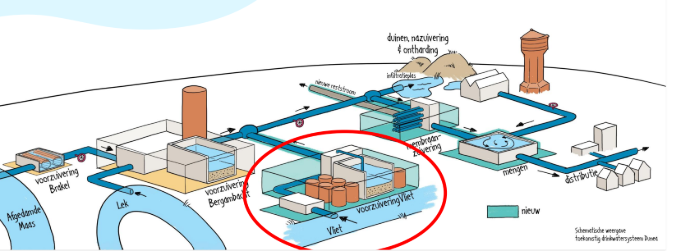
Dunea is investigating whether surface water from the river Vliet can help secure future drinking water supplies in the western Netherlands. The NEW WATER pilot will test how this challenging water source can be treated and integrated into Dunea’s existing river-dune system.
The aim is to diversify water sources and strengthen resilience as climate change and growing demand put existing supplies under pressure.
Pilot process
planned pilot flow rate
potential additional capacity at full scale
currently supplied by Dunea
Pilot flow may change as the installation is scaled. The annual capacity refers to potential future full-scale production, subject to validation and implementation.
Why regional surface water, why the Vliet?
Location: De Vliet / Scheveningen pumping station, the Netherlands
Pilot lead: Dunea
Source: regional surface water from the Vliet
Intended use: future drinking water supply to households and industry through the public distribution network
A densely populated region needs additional drinking water sources
Dunea supplies drinking water to approximately 1.3 million people through a system that combines river water and dune infiltration. Population growth and climate change are increasing pressure on this supply.
Following an environmental assessment and stakeholder consultation, the Vliet was selected as a preferred additional source. Its water is affected by urban, agricultural and industrial activities, so further treatment testing is needed before it can contribute to drinking water production.
Collect
Take surface water from the Vliet as the feed for the pilot.
Pre-treat
Use screening, coagulation and rapid sand filtration to remove particles and prepare the water for further treatment.
Purify
Apply ultrafiltration and granular activated carbon to further improve water quality.
Assess
Evaluate blending with existing pre-treated Rhine and Meuse water and integration into Dunea’s drinking water production system.
Preparing a new source for an existing water system
Screening and pre-treatment
Drum screening or microsieving removes larger particles from the incoming surface water.
Coagulation with iron dosing and rapid sand filtration provide further pre-treatment. The pilot will assess how these stages perform as source water quality changes.
Advanced treatment and blending
Ultrafiltration and granular activated carbon provide additional treatment before the water is considered for blending with existing pre-treated Rhine and Meuse water.
The pilot will assess treatment performance and compatibility with Dunea’s wider production system.
What the pilot will assess
Source water and contaminants
How do seasonal changes and pollution affect treatment requirements? The pilot will assess water quality challenges including PFAS, pesticides, other micropollutants, organic matter and salinity.
Treatment and system integration
Which operating conditions provide reliable treatment for this source? The pilot will evaluate how treated Vliet water could fit into existing water streams and future infrastructure.
Implementation and stakeholder support
What is needed to develop the source in a densely populated region? Future implementation will require coordination with municipalities, water boards and other stakeholders, alongside the necessary permits.
Diversifying the region’s drinking water sources
The pilot will provide knowledge needed to assess the Vliet’s contribution to future drinking water supplies. At full scale, this regional source could support approximately 10 million m³ of additional drinking water production each year.
Developing an additional source could strengthen long-term water security and complement Dunea’s existing river-dune system.
Lessons on treatment performance, system integration and stakeholder engagement could also help other drinking water utilities assess regional surface water sources across North-West Europe.
NEW WATER can help you take the next step
Reach out and make your company more water-resilient.