
A new water source for industry in Almelo
Almelo, The Netherlands
At Vissedijk wastewater treatment plant in Almelo, treated municipal wastewater could become a resource for local industry. The NEW WATER pilot will test hollow-fibre nanofiltration to produce water of drinking water quality for industrial applications.
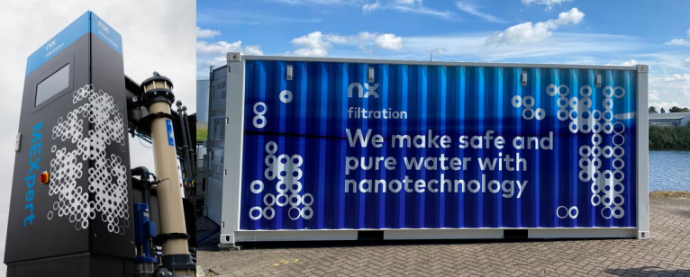
Led by NX Filtration, the pilot will assess a compact treatment system designed to reduce demand for freshwater and support local water reuse.
Pilot process
planned pilot flow rate
effective membrane pore size
design capacity of Vissedijk wastewater treatment plant
The flow rate is a pilot design value; treatment performance remains to be validated.
Why treated wastewater, why Almelo?
Location: Vissedijk wastewater treatment plant, Almelo, the Netherlands
Pilot lead: NX Filtration
Source: treated municipal wastewater
Intended use: industrial applications requiring drinking water quality
Local industry needs reliable water supplies as freshwater resources come under pressure
The Vechtstromen region is increasingly affected by drought. Dependence on rainfall and limited external water supplies makes the area vulnerable during prolonged dry periods.
Meanwhile, treated municipal wastewater leaves Vissedijk every day. The Almelo pilot will investigate how this existing stream could become an additional water source for industry, reducing demand for conventional freshwater supplies.
Collect
Use effluent from Vissedijk’s existing municipal wastewater treatment process as the feed for the pilot.
Pre-treat
Test optional aerated pre-treatment to assess whether it improves downstream performance.
Nanofilter
Apply hollow-fibre nanofiltration as the core treatment technology.
Assess
Test optional electrodialysis and assess the treated water against the quality requirements of its intended industrial use.
Testing a compact treatment system
Hollow-fibre nanofiltration
NX Filtration’s membranes have an effective pore size below one nanometre. The pilot will evaluate their performance in treating municipal effluent and removing relevant contaminants.
The concept aims to achieve high water quality with limited pre-treatment and reduced chemical consumption.
Optional treatment steps
Aerated pre-treatment can be tested before nanofiltration, while electrodialysis can be evaluated as a subsequent treatment step.
The pilot will assess the added value of these options and identify which configuration provides reliable performance with an efficient treatment process.
What the pilot will assess
Water quality
How effectively does the treatment remove pathogens and trace contaminants, including pharmaceuticals and PFAS? The pilot will evaluate performance against its drinking water quality objective.
Stable membrane performance
How do changes in wastewater composition affect treatment? The pilot will assess membrane fouling and the operating conditions needed for reliable long-term performance.
Treatment configuration
When do aerated pre-treatment and electrodialysis improve the overall process? The pilot will explore how to combine treatment steps while limiting complexity and chemical consumption.
Creating a local water resource for industry
The pilot aims to recover several thousand cubic metres of water each year that would otherwise be discharged. Using this water for industrial applications could ease pressure on freshwater resources and strengthen resilience during dry periods.
The treatment system is designed as a modular, containerised unit with automated operation and remote monitoring. Its capacity and treatment configuration can be adapted to local needs.
The findings could support deployment at other municipal wastewater treatment plants and industrial sites across North-West Europe.
NEW WATER can help you take the next step
Reach out and make your company more water-resilient.